Tuesday, May 06, 2008

Eternal Punishment

This post arises out of a discussion on the Facebook Group "The Bible Study Facebook Group" on the Existance of Hell and Eternal Punishment. If you have a Facebook account you can check it out at: http://www.facebook.com/topic.php?uid=6405009186&topic=4746 - Oh join the group while you're there.

As some of you are aware, this “essay” has been worked on over a few days and as such, some of the points that are mentioned here may in fact have been made by other contributors. My objective in writing this is to examine the idea put forward by Nicole that at some point the souls of those who are lost will cease to exist, and consequently to research what seems to be an inconsistency is what Scripture teaches in regard to the fate of those who are not saved. I apologise for the length of this post but it is necessary to do justice to what is a very serious matter.

I have found in my study of the Bible, that from time to time one will come across, or have pointed out to you by a skeptic, a prima facie contradiction in what is said in one part of the Bible in relation to another, and between what is recorded in the Bible and what appears to be the facts in reality. There are “theologians” – albeit non-believing ones, who make it their life’s work to disprove the Bible. A case in point is Richard Dawkins who wrote The God delusion. There are issues such as:
  • “The Problem of Evil” – in other words: if God is omnipotent and all-loving, how could he allow the existence of evil.
  • There is the whole “Predestination versus Free-Will” discussion that has resulted in schisms in the Church.
  • You may be asked if you are amillennialist, premillennialist or postmillennialist – and you may be justified in saying that is a preposterous question. (get it? A – PRE – POSTerous: Thanks David Pawson.)

The point is that all of these discussions including the one that is exercising our minds here: namely the meaning of ETERNAL PUNISHMENT is that they are based on our understanding of what the Bible teaches. As Nicole said, many people claim to be basing their theologies on the Bible, but since people are coming to conclusions that are diametrically opposed, it must mean that one or both of the parties are mistaken about what the Bible is saying.

If, as we do in this group, we agree that the Bible is God’s inerrant word – in other words there are no mistakes and we understand that if there were contradictions in the Bible they would represent a mistake, we have to come to the conclusion that THERE ARE NO ACTUAL CONTRADICTIONS IN THE WORD OF GOD.

I used the expression prima facie before – this is a legal term meaning “on the face of it” – A prosecutor can take an accused to trial based on prima facie evidence that the accused committed the crime, however, it is up to the court to determine if in fact that prima facie evidence is true before they can convict the accused of the crime. In the same way, when we come across what appears to be a contradiction we must not accept it at face value but research more deeply and really understand what the Bible is saying, and we will then, I am confident, see that there was no contradiction after all, but that we had misunderstood what the Bible was saying.

Since we are discussing the nature of eternal punishment, let us look at a very well known verse: John 3:16.
“For God so loved the world that He gave His only begotten Son, that whosoever believes on Him (the Son) shall NOT PERISH but have ETERNAL LIFE.

Looking at this verse and seeing what we can learn from it I discover that there are two possible outcomes spoken of here: 1) Perishing 2) Eternal Life. It would seem therefore that since the “reward side” is ETERNAL LIFE that the “punishment side” would be exactly opposite to eternal life. Well, one could conclude that therefore it is, if you’ll the excuse expression “non-eternal death”. I am however making too many suppositions here. It is not necessarily “non-eternal death” but ETERNAL DEATH that is the opposite of ETERNAL LIFE. However, the question remains, and cannot be answered by this verse alone, what is the nature of this death? Does death really mean one ceases to exist?

Based on Hebrews 9:27, which says, “It is appointed unto man ONCE to die and THEN the judgment, we can ascertain that DEATH is not the endpoint in a human’s existence. We know that in physical death, a corpse does not dematerialize. It remains and those who are nearest and dearest have to dispose of the corpse, either by burial or by cremation. As the years go by, that body breaks down and gradually over many years, becomes part of the environment it has been placed in. A basic knowledge of science states that matter is not destroyed. It changes but it does not simply disappear. God does have the right to eradicate the souls He has created, but the Word of God suggests that this He has not done and has no intention of doing.

It is appointed unto man that he should die once and then face the Judgment. The questions remains, “What about after the Judgment?” If we look at the parable of the sheep and the goats, Jesus says in Matthew 25:46 “And then they (the “goats”) will go away to eternal punishment but the righteous to eternal life.” Here we have a juxtapositioning of eternal life with eternal punishment.

J.C. Ryle, commenting on this verse says

The state of things after the judgment is changeless and without end. The misery of the lost and the blessedness of the saved are both alike for ever. The eternity of God and of heaven and hell all stand on the same foundation. As surely as God is eternal, so surely is heaven an endless day without night and hell an endless night without day.” Ryle J.C. (Sheehan R. ed.) Daily Readings from all four Gospels for Morning and Evening, 1998, Evangelical Press, Darlington, England, November 3 Morning

As David has already indicated in other passages so it is here – the same word “eternal” describes both the punishment of the wicked and the life of the righteous – and thus in regard to the dimension of time, the property of both of these outcomes is alike.

I wanted to come back to the use of the word “perish” as it appears in John 3:16. Watching a DVD the teaching on the End Times, David Pawson said that that word – “Perish” does not mean – to be destroyed, but to become useless. A tyre-tube that perishes becomes unusable – you can’t pump it up as it has holes, and so you chuck it out. Jesus spoke about the Salt and the Light. He said it the salt loses its saltiness it becomes useless – you chuck it out. The actual Greek word for perish is not used in that context. However, I have done a word study on Perish and I find something rather interesting.

The Greek word for “Perish” in John 3:16 is “apolaetai” and appears seven other times in the New Testament and it is used twice in the Septuagint (Greek translation of the Old Testament).

  • Matthew 5:29 + 30 “It is better for you to LOSE (destroy) one part of your body than…”
  • Matthew 18:14 “It is not the will of your Father in heaven that one of these little ones PERISH” (Parable of the lost sheep)
  • Luke 21:18 “But not a hair on your head will be DESTROYED” – context Jesus was prophesying what would happen to us at the end of time.
  • John 3:15 + 16 – We know what it says there – it is interesting however that verse 15 says virtually the same thing as verse 16 – verbatim.
  • John 6:12 “Let nothing be WASTED” – context after feeding 5000.
  • John 11:50 “Do you not realise it is better that one man die for the people than that the whole nation PERISH.”

    Old Testament
  • Deuteronomy 22:3 – Speaking of animals that had STRAYED or any item that had clearly been MISLAID and the responsibility of a person finding the animal or item to return it to its rightful owner.
  • Isaiah 38:17 – “Pit of CORRUPTION” – also pit of DESTRUCTION –

Summary:

Looking at the use of these words the general idea of “apolaetai” is “to be lost” - Therefore applying this meaning into John 3:16 – “Shall not be lost, but have eternal life.” Removing thus the incorrect notion of obliteration – which I find nowhere in Scripture, we have the idea that the two possible outcomes described in John 3:16 are: Eternal life for the righteous or being lost forever for those who do not believe.

I therefore conclude that John 3:16 does not preclude an eternal punishment for those who do not believe. In the light of other scriptures, I feel that an eternal lake of fire does await those whose names are not written in the Lamb’s book of Life.

Sunday, April 13, 2008


Benji gets very excited when he notices strange animals on TV!
Posted by Picasa

Thursday, March 06, 2008


Learning Difficulties - or is there more to it?

http://uk.news.yahoo.com/pressass/20080306/tuk-learning-difficulty-adults-degraded-6323e80.html

The headline: "Learning Difficulty adults degraded" screamed for attention. I am one who will always campaign for the rights of the disabled. I urge you to read the article above, but if you haven't got time, you can read the following summary:
A Joint Committee on Human Rights for the UK Parliament has found that there is widespread mistreatment of adults with "learning difficulties" throughout Britain. Two specific cases were highlighted:
  1. A man with Down's Syndrome was locked in a minibus for a whole night and his foot was broken by one of the so-called carers.
  2. A 20 year old died as a result of serious health problems after spending 96 days (Almost 14 weeks) in an NHS psychiatric assessment unit without the appropriate staff to support him.

This makes my blood boil that people so vulnerable can be treated in such a cavalier and uncaring fashion, and I hope and pray that now that the Joint Committee has exposed the abuse, that there will be swift action and that those responsible for harmful abuse, as in the case of the Down's Syndrome man will be dismissed and never allowed to work with disabled people or any child ever again, and where neglect is the problem that will be attended to.

However I would like to address an issue that also irritates me and that is how the media refer to such people. It seems that in an attempt to be politically correct, the term intellectual/mental disability is being shunned and the term Learning Difficulty is put in its place.

Here's where I stand on this - Learning Difficulty does not accurately or completely describe what these people are experiencing - true, as a result of the 'problem' they may experience "Learning difficulties" - but the learning difficulty is not the sum total of their challenge. Also,

Generally "learning difficulties" are associated with children, and we do not usually associate learning with adults in other contexts - Even when we talk about an adult who is undergoing tertiary education or further training, we tend to prefer the term "studying" or "training" - Thus this very term is a put down as it immediately associates them with children. Also, we seem to have no problem acknowledging if a person is physically disabled referring to the disability as a disability and not creating unnecessary euphemisms, and where people do try to do this, the disabled person will usually give them short-shrift, and tell them, I'm blind/paraplegic/have cerebral palsy and if you can't handle that fact, you are the one with the issue - not me. The thing is, due to the nature of the problem, people with intellectual disabilities are unable to understand the issue and its implications - so well-meaning people such as myself attempt to speak on their behalf. My contention is that by euphemising (if that is not a word - it should be) you are implying that there is something shameful about the fact that the person has an intellectual disability.

Not too long ago, it was regarded as something shameful to have cancer. If the term was used at all, it was whispered. When HIV and AIDS first reared its head, due to the way the disease is tranmitted from one person to another, it had such a huge stigma. Now thankfully most people are more sensible about these things realise that they are diseases and that being ashamed is pointless and unhelpful. Instead, realising that one has the disease, one can get the necessary intervention, that if it cannot cure it, can at least, make our lives easier with it.

Well there is no shame in having a intellectual disability either - and as soon we send that message load and clear, we can also more easily tackle the abuse spoken about in the article.

Another aspect of the labelling such people as having "learning difficulties" is that those with real learnig difficulties, such as people who cnnot read (maybe due to dyslexia) or struggle to retain information, are bracketed together with people who have intellectual disability and thus unnecessarily stigmatises them, and may hinder any remedial action to help the person who cannot read from learning to read. This will stigmatise learning difficulties and thus people who experience barriers to learning may resist getting help and will suffer in silence rather than expose their deep secret.

Let us fight stigma in all its forms so that we can be more caring communities that accept all people as they are and realise that no matter what difficulties a person experiences in life, that they are accepted and valued and not discriminated against.

I really want comments on this one!

Sunday, January 20, 2008


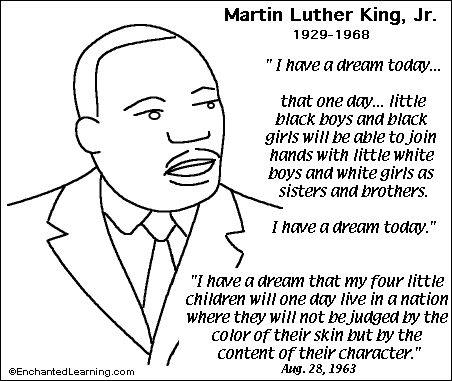
Martin Luther King Day
(January 21st, 2008)


Well I don’t usually write about secular holidays but this is one I am willing to make an exception for. The more I hear and read about this man, the more I like him. No – I don’t put him on a pedestal, and I am prepared to accept that he had human failings like other people, but he was at the front of the Civil Rights movement of America, and in that, he exhibited bravery that is seldom seen in this day and age.

I was just watching a retrospective documentary on his life on CNN, and it was very interesting to hear a first hand accounts of the people who worked closely with the man. In the past, I have heard snippets here and there, bits about the bus boycott, and the march on Washington, oh, and who hasn’t heard about the famous “I have a dream” speech, and his assassination at a motel in Memphis. It was good to hear how these things linked together. I think I need to watch that documentary again, just to make sure I didn’t miss anything.

On a personal note, something that really made an impact on me was the coincidence of his dates with mine. He was 39 when he was killed, – I’m 39. He died the year before I was born, 1968. I was trying to find out why the holiday is set for this time of year. It turns out his birthday was 15th January 1929, forty years, almost to the day before I was born. My brother was congratulating me yesterday on earning my degree before I turned 40 – well, I think Martin Luther King put that achievement into perspective. (This is not to say I am not pleased with my achievement. It was hard work, and I am glad I did it, though I always say that it was only with God’s help that I have succeeded.) Martin may have been a very young man, but he had an “old head” on those young shoulders. He spoke passionately and so well. He was described on that documentary as a poet. I believe that is right.

So what impresses me about Martin Luther King?

  • His resolute stand against violence. He told his followers at the end of the bus boycott, when they got back on the buses that if anyone struck them, they should not retaliate, and that if it got too difficult they should rather get off the bus and walk some more than to respond in kind. This was his consistent stand as far as I could gather.

  • His genuine belief in the Gospel. You may be sceptical, but I believe when I hear the words of Martin Luther King that they were consistent with the Gospel. In a sermon on “Loving your enemies” he said that regardless of what the white people would do to him, that he would continue to love them, and ultimately he would win. He spoke about having gone to the mountain top (after winning the Nobel prize), but having to return to the valley. In his Speech on August 23, 1963 on the steps of the Lincolm Memorial, he said “I have a dream today. I have a dream that one day every valley shall be exalted, and every hill and mountain shall be made low, the rough places will be made plain, and the crooked places will be made straight, and the glory of the Lord shall be revealed and all flesh shall see it together. (This is talking about the Second Coming).

  • He was, a humble man. He was awarded the Nobel Peace Prize in 1964, he accepted it, on behalf of the negro people who at that time still faced discrimination.

  • He was a man who did not fear man, but God. Speaking about the now famous speech in which he said “I have a dream” – his advisers had told him not to use that bit. He said, “Thank you for your counsel but now I will go and consult with my Lord.” He went ahead and said “I have a dream…” and the rest as they say is history.

Some might wonder why this white South African boy is interested in a political leader from the States. Well it goes beyond the mere coincidence of the dates, but it is because what Martin Luther King helped achieve in America, has had international implications.

It started in the USA, with the Civil rights movement where the message came loud and clear that it is not right for one race to dominate and persecute another, to use and abuse people or to regard them as inferior. It started there, but the message spread, and countries such as Rhodesia (now Zimbabwe) and Apartheid South Africa became pariah states subjected to international sanctions because of their policies of racism. It began with Martin Luther King, and spread, even after he was brutally gunned down in 1968, the effects of what he did and stood for, reverberated though history. I wish more political leaders of this era would take a leaf out of Martin Luther King’s book and be willing to stand up against injustice, rather than being the perpetrators of injustice themselves.

Who knows, but maybe on Martin Luther King Day (next year), the first black president, Barak Obama could be sworn into office.

Martin Luther King, like his namesake of the reformation, was a revolutionary. But in noting that his weapons were not AK47’s or violence, but peaceful resistance, speeches and writing, we see a man who stood up against injustice, and even though he paid an awful price for his troubles, not only in his assassination, but in his being thrown into prison numerous times, and beaten and badly treated, he refused to back down.

I honour this man.

You can read the whole text of the “I have a dream, speech” at the following link.
http://usinfo.state.gov/infousa/government/overview/38.html

Monday, December 03, 2007

Chanukah

Christians often refer to the “time between the Testaments” a period of time that lasted from the time of Malachi to the time of Jesus - about 400 years. For the most part these were “the silent years” but something very significant happened in the land of Israel during that period that is still celebrated in Israel to this day. It is significant, and not without irony, in my opinion, that this celebration is one about light. In the midst of “the darkness” God shone forth in the miracle of Chanukah.

Chanukah means “dedication” and the festival of Chanukah celebrates rededication of the Temple in Jerusalem to God in 164BCE or 165BCE (depending on which sources your read) after the successful ‘rebellion’ of a small group of faithful Jews, who retook Jerusalem from the Hellenistic leader “Antiochus.”

At that time, Israel was under the political dominion of the Seleucids, whose king was Antiochus IV. They entered the precincts of the Temple and defiled it utterly. They also banned the study of the Torah and did everything they could to cause the Jewish people to be assimilated into the Hellenist way of life and to leave the worship of God. There was however a group of faithful Jews who put loyalty to their God before political expediency and led by a man called Matitiyahu and then later, his son Judah the Maccabee; this group rebelled against Antiochus IV. Antiochus tried to put down the rebellion, but eventually the “rebels” prevailed and succeeded in routing the Hellenists and they retook Jerusalem.

Having attained the military victory, they went back to their Temple, but they had to remove all the things which did not belong, and to restore those things which had been desecrated in the Temple and to rededicate to God. They wished to light the Menorah but they had to use pure oil that had not been desecrated by the Greeks. They searched the temple and found just enough to keep the Menorah lighted for just one day. It would take eight days to make more. They lit the menorah with that little amount of oil, and God kept it burning for the eight days that they needed to make more. This truly was a miracle and one worthy of commemoration.

So, Chanukah came into being. In doing research for this article, I realised that Chanukah has more in common with Christmas than the time of year in which it is celebrated.
  1. Christmas and Chanukah are not mentioned in the Bible.
  2. Both celebrate the lighting of a light – stay with me on this one. The Christmas ‘light’ is the coming into the world of the ‘light of the world’ (John 8:12), Jesus.
  3. Both celebrate a miracle – Chanukah: one day’s oil lasts eight, Christmas: The virgin birth.
  4. The followers of Judas the Maccabee, and Jesus the Nazarene, were regarded by their fellow Jews as rebels.

Is it appropriate for a Christian to celebrate Chanukah? I’d love to hear your opinions on that, but I say a resounding YES. Even though Chanukah is not mentioned in the Torah as a “prescribed feast” as is Pesach, Sukkoth, and Shavuot, we can see God’s hand in restoring worship of the true God in Israel during this time that there was no prophet in the land.

Christians are also not required to celebrate Christmas, but we do celebrate the miraculous birth of Jesus, coming into the world to redeem humanity from sin. Through Jesus, a person can be restored and rededicated to God.

As a part of the celebration of Chanukah, each of the eight evenings, people light an additional light on a special Chanukah Menorah (with nine lights – eight lights – plus a helper light). So on the first night, they light one, the second night two, etc. Maybe you don’t have a special menorah, but if you want to, why don’t you find nine candles (one can be a stumpy candle (as a helper) and line them up, and then light one (more) each evening (starting on 4th December this year.) As you do, say a prayer, and thank the Lord for the miracles that he performs.

One last word: it is sometimes easy to overlook the miracles that God does. ‘Simple’ things like making oil last longer than it normally does, can and often does get overlooked. I’m convinced that God does a Chanukah miracle in my petrol tank from time to time. Let’s give thanks to the lord for the “little interventions” that we may take for granted. In light of that, I have just had an operation. It was, I’m sure in terms of medical science, pretty ordinary and straight forward, but for me, the operation was a sign of God’s hand at work. I was told that I may experience bad pain after the operation, but I can testify here that I have had no more than a small degree of discomfort – God’s Hand at work.

Happy Chanukah
John

I used a few references to ensure that I had an accurate account of what Chanukah is all about: Here they are:

http://www.aish.com/chanukahbasics/chanukahbasicsdefault/What_is_Chanukah$.asp

http://www.aish.com/chanukahbasics/chanukahbasicsdefault/Matityahus_Revolt.asp (Some more background - I liked the following quote from this page:
For the Maccabees, it was not Jewish physical life that was at stake, but the spiritual life of the Jew. The name "Maccabee" is an acronym for the Torah verse "Who is compared to You among the mighty, oh Lord" (Exodus 15:11).
http://www.chabad.org/library/article_cdo/aid/329373/jewish/Eight-Lights-Eight-Lessons.htm (Excellent essay with a spiritual application to the festival of Chanukah, written by a Rabbi)

http://www.templemount.org/0240.html (Excellent essay on the Silent Years)

http://www.torah.org/learning/yomtov/chanukah/chanbasics.html

http://www.wels.net/cgi-bin/site.pl?1712&cxDatabase_databaseID=4&id=6


http://en.wikipedia.org/wiki/Chanukah (This is useful for a more full account of history that I could not go into in this article.)

Sunday, October 21, 2007

Floating on the Dead Sea - Boy's life saved.

Boy,8, rescued after spending night floating alone in Dead Sea
Last updated at 11:14am on 6th August 2007

To read the actual story, follow the link.
http://www.dailymail.co.uk/pages/live/articles/news/worldnews.html?in_article_id=473453&in_page_id=1811

Earlier today, I was Googling for some pictures of the Dead Sea to put on my new "Bible Study Facebook Group" to go with the Bible Study we are doing and came across this heartwarming story.

The Story really says it all, but I just wanted to remark on one or two things.


The boy was dehydrated and frightened but otherwise healthy, he said. Shneur told his rescuers he remained calm throughout the ordeal, saying prayers and thinking about his school friends as he floated in the darkness.

This is completely amazing. dehydrated and frightened but otherwise healthy.

He was not shivering to death. Okay, I think that it is pretty hot in that part of the world, but the boy was in water the whole night!

Secondly, how he said he kept calm: this is a miracle! I note he said prayers. I have a sense that he knew he was not alone out there, because could lie back and float in the water, not panic, and not, despite being thirsty, trying to drink the water.

Yes, the report did say he was alone, but the journalist obviously didn't take into account the presence of God with that child. It was not the salt in the water that held him afloat - it was God himself.

This reminds me of two occasions when I was in potentially dangerous situations and the Lord, not only rescued me, but comforted me, through the ordeal.

When I was about 5, Our family were camping in the Rhodes Inyanga National Park (now known as Nyanga National Park). As I was very little, my parents took along with them a domestic worker, known as Babaford (Sorry, i'd like to be PC, but that's the only name I ever knew). Anyway, I was in a dwaal* most of the time, and I was quite content with my own company. I think Babaford was busy tidying up the campsite, and I wondered off into the woods, and i didn't even drop breadcrumbs behind me! I was playing. I don't know how long or how far I wondered into the forest (surrounding the campsite and most of the Nyanga district were Pine trees. ) It is important to note that at that time (1975), Rhodesia was at war with the freedom fighters. Nyanga was a "hot area" and although they did not close the National Park, wandering away from the campsite was not a good plan. However, little Johnny sallied forth with gay abandon (apparently)**

My parents returned to the camp, some time later, and they looked around for their little one, but he was nowhere to be seen, There was some desperate searching going on, not least, by poor Babaford had not noticed that I had wondered off.

Meanwhile, while in the depths of the forest, I heard someone talking to me, He must have been up in the trees, because I looked up, and I talked to Him. Anyone who might have noticed me would have seen a little boy chatting away, but they would have not seen the One he was talking to, since, that person was invisible to everyone, except this one little true believer down on the ground. Anyway, this character, whose, apparently was "Abba" said that he would send his "son" to take me back to the camp, and so, I found myself after a little while, but not a moment too soon, back amongst the tents, and where my parents, and Babaford saw me, to their great relief and I recounted in my childish way, how I met "Abba." By the way, my relating of this story is based on what my mother told me many years later. I do clearly remember having imaginary friends called "Abba" and "Amma" but the details thereof I had long forgotten.

My point in sharing this story is that despite being in severe danger, because of the war situation, I was protected and I was also shielded from fear. I have no doubt that thereafter, Babaford kept a closer watch on his ward and didn't let him wander off again. Later, "Abba" and "Amma" just became imaginary friends, like many children have at that sort of age, but I'm sure, just as my mum is, that in that instance, in the pine forests of Nyanga, "Abba" was no figment of my imagination.

The other time was when i was a lot older, and our family were on holiday on our boat, The Silver Beard, travelling across Lake Kariba. In the middle of the lake, the Audi engine stopped operating and there was a storm brewing. We had a small tender, with an outboard engine, called "Bandit." Dad, got into "Bandit" and towed the big boat back into harbour through what were becoming very choppy waters. This was a very dangerous predicament we were in, and that night the heavens opened over Kariba, and a number (I cannot remember exactly how many) of boats in the marina were submerged, but Silver Beard was still afloat and we slept abourd her that night. I know we had a radio, but I am not sure why we did not radio for help. But although it took Dad a very long time, we found safe harbour. Mum and I were on the big boat and we prayed. I cannot, hand-on-heart, say we were not anxious, but if we were , we should have trusted more, and notwithstanding that anxiety, He saw to it that we survived.

So there you have it, three stories for the price of 1 - bargain!


*dwaal an Afrikaans word that means a dreamy state
** DO NOT MISCONSTRUE THIS SENTENCE! "gay abandon" according to my dictionary means - "without thinking about the results or possible consequences"

Tuesday, October 02, 2007


"I ought to be dealing with tomorrow night’s game -- not this crap. It was the kid’s fault."

-- Muskogee High School (Phoenix) football coach Matt Hennesy’s response after his car collided with a 7-year-old bicyclist and he left the injured boy with a trainer so he could attend a team dinner.

I saw this quote in an email I got this morning. It astounded me that a person could be so crass, but it is always good to get the other side of the story. I thought I should look deeper into this and see what happened. See the following article from which I sourced my info. http://newsok.com/article/3125918/1189789027 - There are myriads of comments attached to this article arguing for and against Matt Hennessy. I am aware that this article may contain factual errors, but for the sake of this article i have taken it to be a fair representation of the facts. I do note, with a certain amount of concern, that the young victiim in this story, and the Journalist who wrote the story share the same surname - of course, it could simply be coincidental - but off all the same. I tried to find a mugshot of the coach, but no such luck.

Hennesy is deeply upset that his words have been taken out of context and he is being made out to be a ‘monster”.

This story raises many questions in my mind, but first, let me deal with the facts, as far as I can ascertain.


The coach is driving his car out of a parking lot at 6 pm in Oklahoma.
A seven-year-old cyclist rides his bike into the road and collides with the coach’s car.
The boy is hurt. Hennesy said he was looking in the other direction – presumably to see if the road was clear so that he could join the traffic.

The father is called but says he was busy taking care of another child, a baby, and would come as soon as possible. Apparently, the father never did materialise. Nor did he phone back.

Amongst the witnesses was a nurse who allegedly told Hennesy he could go as she would attend to the injuries. Nobody called the police.

OK – What’s a seven year old doing riding his bike in a public place, completely unattended? It is around 6 p.m. This is early evening – even if the sun has not set. The fact that the boy rode his bike into a car means that he is not yet a competent cyclist and if he is going to ride in public places, should be accompanied by a competent adult, who might have prevented an accident occurring. We do not know, and cannot determine whether the child had had permission to be where he was when he was. Maybe he slipped out unnoticed and decided to go to the shops for whatever reason. This is quite feasible as little children do do these things. If that is the case, the little boy was being very naughty – but that being the case, it still does not make him responsible for the accident. Hennesy is right not to lay a charge against the little boy, but not for the reason he states – the boy is not responsible for that accident. Considering what could have happened to an unaccompanied 7 year old in today’s world, I’d say that he was actually lucky. I think that there is a prima facie case of child endangerment here – but let’s not go down that road.

Turning our attention to Hennesy – he says he was looking in the other direction. What seems odd to me is that the child should sustain as serious injuries as he did if Hennessy’s motor vehicle had been stationary at the moment of impact, but it would depend I suppose on the speed that the youngster was doing. I suggest that he had not come to a complete halt at the moment the child collided with his car. We are not told if the child was approaching from Hennesy’s right or left, or if the road was going up or downhill, but from my understanding, where a vehicle entering traffic has to yield, he has to ensure that the road is clear from both sides before proceeding. Did Hennesy do this? It is possible that he did, except, it is possible he did not notice the seven year old on his bicycle, concentrating instead on big vehicles. Actually, as the accident is described, the seven year old was on the road that Hennesy was attempting to enter, and would I think, constitute part of the traffic to which Hennesy would have to yield. However all this would be subject to a forensic investigation, or at least should be. It’s not up to the coach to ascribe blame for the accident.

Now, to after the accident –
Was the child lying on the ground after the accident, or had he already scrambled to his feet on his own? Much has been said about not moving the victim of an accident, but it is not clear that he did not move himself.

There was a nurse on the scene, and from the report, it seems she took responsibility for the boy and attended to his injuries – I’m sure she was competent at her job. The child was removed, carefully, to the training-room of Hennesy’s team. The boy’s dad was contacted and said he would come as soon as possible – this is really odd.

I can’t quite understand this – surely if one’s young son had been hurt – and you’re phoned and told about it – you drop everything – okay – don’t drop the baby! – but you give the baby to another adult – a mother perhaps – there must have been somebody, or if there is no-one, come with the baby, but whatever you do, come!

Here comes a pet peeve – why was his name published? Minors’ identities should be protected and not published in full, unless it is in a positive light, such as winning a competition, or performing in a show (where the parents have signed a waiver) or in cases where there is need for the child’s name to be known – such as in the Maddy McCann case.

Mr Hennesy, it is the DRIVER’S responsibility to call the police after an accident, not the Nurse’s – or anybody else’s. You should have done that. Surely if you are a holder of a valid driver’s licence you know that much? Don’t blame the nurse – she was concentrating on the child’s well being and even if she said you could go, it was not to go and have dinner – you could have then gone to the police, or phoned the boy’s dad and asked him where he was, so that you could go and fetch him. You should not have moved your vehicle until you had been given the all clear by the police. Did anyone think to take photos (with a camera phone) of the scene? Would you have passed a breathalyser test? Presumably, if you had just left a training session, this would not have been necessary, but then again, you may have had a quick beer after training. No-one can tell now, and if they tested you later – you could always claim you had had something to drink at the dinner.

Mr. Hennesy, I’m sure you’re no monster – but I would say you were kind of crass and certainly we can wonder about your driving competence. Thankfully, sir, the child does not seem to have sustained any permanent injury, but I wonder if, perhaps in the light of everything that occurred, assuming the parents don’t sue you, that you take the initiative and offer to pay for him to see an orthopaedic surgeon. The boy had a “knot on the head” – an expression I am not familiar with but presume it was a bump – just as a precaution, perhaps he should that checked out.

Please, please, post your opinions -
Thanks to mapquest for the Satelite image.

Friday, September 28, 2007


To be a Christian without prayer is no more possible than to be alive without breathing.
Martin Luther King, Jr.
The world was robbed of a wonderful human being when this man was assasinated, however he was not robbed of life as he is with the Lord.

Sunday, September 16, 2007

Failure
-------

Adam trudged past the gates of Eden, his head low, his feet heavy with remorse and pain.

Then he stopped, spun around and exclaimed, "Wait a minute! You had this all planned! You put that fruit there knowing I would eat from it! This is all a plot!"

There was no reply.

Without failure, Man can never truly reach into the depths of his soul. Only once he has failed, can he return and reach higher and higher without end. Beyond Eden.


A Daily Dose of Wisdom from the Rebbe
-words and condensation by Tzvi Freeman
Tishrei 4, 5768 * September 16, 2007

The quote above comes from www.chabad.org

I am not sure I agree entirely with this, but it did provoke some thought!

Firstly let me say, I am not sure that it is accurate to say that "this is all a plot" - I say this with great caution as we serve an omniscient God who knew all things from the beginning. My objection is merely that this seems to lay the blame for the "fall" at God's feet.

Nevertheless, this is what I do agree with - all of us have experienced failure of one sort or another in our lives. We can let that God can turn our failures around if we let him, and it is through our failures more often than our successes that we grow and progress. That may sound contradictory - progress through failure raher thqan success, but it is true. The thing is, when we fail, it does alter our route, and we may take a bit longer to get to where we headed, but sometimes, when we take a detour, we discover things that we would have missed, if we hadn't taken the detour.

Obviously, we do not fail on purpose, but we must face the fact that at some point we will meet with failure, and in those instances, instead of giving up, we should realise that we have detour to take, and ENJOY he ride.

Please let me know what you think of this.

John

Wednesday, September 12, 2007

Today is the last day of the Jewish year, or, it is the first day of the New Jewish Year, depending on what time you actually read this.

Rosh Hashana begins at Sunset today.

Rosh hashana means - The Head of the Year.

I am rather tied up and busy at this time, so cannot do my usual essay - but I wish all my Jewish readers, L'shana Tova (A good year.)

I discovered that part of the traditional meal on Rosh Hashana is the head of a fish. I immediately thought - "Um. pass!" If I had to eat the head of a fish, I'd choose to eat a sardine or a kapenta!

Part of the custom at Rosh Hashana is to go near a body of water that contains fish and recite the following:

Who is like You, God, who removes iniquity and overlooks transgression of the remainder of His inheritance. He doesn't remain angry forever because He desires kindness. He will return and He will be merciful to us, and He will conquer our iniquities, and He will cast them into the depths of the seas.
Give truth to Jacob, kindness to Abraham like that you swore to our ancestors from long ago.
From the straits I called upon God, God answered me with expansiveness. God is with me, I will not be afraid, what can man do to me? God is with me to help me, and I will see my foes (annihilated). It is better to take refuge in God than to trust in man. It is better to take refuge in God, that to rely on nobles.

I got this information from: http://www.aish.com/hhrosh/hhroshdefault/ABCs_of_Rosh_Hashana.asp

Sunday, August 05, 2007


BREAD

And He afflicted you and let you go hungry, and then fed you with manna, which you did not know, nor did your forefathers know, so that He would make you know that man does not live by bread alone, but rather by, whatever comes forth from the mouth of the Lord does man live.

These words were read in Synagogues this week all around the world. It was part of their reading from the Torah, and the words quoted above were taken from a Jewish website, http://www.chabad.org/. I mention this, only to point out what drew my attention to these verses, on this occasion.

The New American Standard Bible puts it like this:

"He humbled you and let you be hungry, and fed you with manna which you did not know, nor did your fathers know, that He might make you understand that man does not live by bread alone, but man lives by everything that proceeds out of the mouth of the LORD. Deuteronomy 8:3(Source http://www.searchgodsword.org/)

Satan Challenged Jesus
After Jesus was baptised in the River Jordan by his cousin, John, he was lead by the Holy Spirit, into the wilderness. He was there for 40 days. He did not eat during this time, and at a certain time, Satan came to him, and tempted him.

“If you are the Son of God, command these stones to become bread.” And Jesus answered him saying, “It is written, Man shall not live by bread alone but by every word of God.”

Satan went on and twice more tempted Jesus to put his own needs above those of His heavenly Father. Twice more, Jesus rebuffed the temptation, by quoting Scripture; however my focus this time is on the “first temptation.”

Firstly let us think a bit about the nature of that temptation. There was nothing wrong with supernaturally making bread – Jesus did this on two occasions, when he fed the 5000 and the 4000. Jesus’ very first miracle was to turn water into wine, at the wedding in Cana, and so we know that Jesus was most certainly not incapable of turning the stones into bread. Also, Satan was goading Jesus, saying “If you are the Son of God…” in effect, he was saying “Go on, prove it. If you really are the Son of God, prove it by turning these stones into bread.”

Satan wanted Jesus to draw attention to himself, and turning stones into bread would have made an instant celebrity out of Jesus. People would have put him up on a pedestal, and may have even worshipped him as the Messiah, but he knew that that would have interfered with the “plan of action” which was to train twelve disciples, and teach them during a period of three years, and then to die on the cross for our sins. In effect, Satan wanted Jesus to take a shortcut, bypassing Golgotha and the tomb, and proceed straight to the throne.

What shortcuts is Satan tempting you to take?

Jesus’ Answer

“It is written…”
As I said already these words are a direct quote from Scripture. Our Lord, who is Himself, God, chose to respond to temptation by quoting the Bible. We can learn that this strategy is the most effective, when we are tempted to do wrong, or to rely on our own strength when we should be depending on God.

“Man shall not live by bread alone…”
Bread in this context is not literally bread, in the sense of a single type of food. We all know that from the purely physical standpoint, this statement is true too, since we need the “balanced diet” comprising dairy, meat, cereals, fruit & vegetables (5 a day), water, various supplements, etc. However we know that Jesus was not speaking about physical sustenance here, but the feeding of our whole being. In this sense, we need a ‘balanced diet” paying attention not only to our physical needs of food, shelter and warmth, but to our spiritual need to be in relationship with our Almighty, and yet personal friend, the Lord God.

From a completely physical perspective, one can survive without relationships, but it doesn’t take a psychologist to tell you that everybody needs a friend, preferably a number of friends. However, you may be the most popular person in town, but if you do not know God, you are not having a balanced diet – and the effect will at some point, catch up with you.

But by every word that comes from the mouth of God.”
Speaking of a balanced diet, one can have an unbalanced diet, with regard to hearing or reading God’s word too. How is that? I hear you ask? Surely anything you read of God’s Word is good for you? It is, but you need to read ALL of God’s word and not only stick to your favourite verses. You need to read from both the New and the Old Testament, from the Prophets and the Pentateuch, From the Evangelists and the Epistles.

As with a physical diet, your diet of God’s word is not only about WHAT you eat (read or hear) but how you eat, the when and the how matter. Imagine a person deciding that they are too busy to keep sitting down to eat, and so they decide that at the beginning of the week they will have one major meal that they consume at one sitting. It is such a large meal that they take two to three hours to work through their 7 course meal. It perfectly balanced diet in the sense of having a correct balance of the various nutrients, and taken over a week, it is a reasonable quantity of food. However, any doctor can tell you that this person is in danger of killing themselves. Their bodies would not cope with all that food, and most of it would pass out of their system as waste. Directly after the meal, they would probably say, I could quite happily never look at another meal, but by the next day, their body would be craving more food and by Thursday, they will be listless, lacking energy and probably sick. Yes this is completely ridiculous, and nobody would think of operating in this way, and yet, when it comes to God’s Word, a number of people will try to survive on one or perhaps two meals in the week. How ridiculous is that?

As with our physical body, our spirits/souls need exercise too. If we eat a very balanced diet, but never exercise, or exercise too seldom, we do not burn up the energy that that food puts into our system and we become overweight, and our organs take strain. In order to be fit, we need to eat the right food, at the right time, and exercise too. The more we exercise, the stronger we become. James says “faith, without works, is dead.” (James 2:14) We may know our Bible thoroughly, but if we do not put that knowledge into practice, the knowledge itself is useless, and we remain, spiritually dead. No – we need to apply what we learn through reading or hearing God’s Word in our lives by our conduct. As it says in Philippians, we must work out our Salvation, “with fear and trembling.” (Phil. 2:12.) This does not mean we have to work to be saved – we cannot, but it means that having been saved, we live accordingly.

How balanced is your diet? Are you exercising sufficiently?

Sunday, July 22, 2007


Not a major sermon this time, just a thought that came out of a Scripture I read today.

The text: 1 Chronicles 17 + 18

http://www.biblegateway.com/passage/?book_id=14&chapter=17&version=72

http://www.biblegateway.com/passage/?book_id=14&chapter=18&version=72

Asa was a worldly king of Judah. The Bible says that he refused to rely on the Lord, either in battle or in his illness. Instead he relied on dodgy alliances in battle, and physicians in his illness. He died and his son, Jehoshaphat, became king. It seems Jehoshaphat took a different path, because he decided to follow God and not “the practices of Israel” – referring to the rebellious and idolatrous tribes that defected from the kingdom and started their own nation. Jehoshaphat followed God, and God prospered him. We read that he sent officials throughout the land to each town and village and the Levites and the Priests taught the people the Law of God – i.e. God’s word. He actively chose to turn his people back to God so that they could be HIS (God’s) people. Remember that under the 41 year reign of his father, the people had turned to idolatry and false religion, and now, they needed an emergency intervention in order to get them back on track.

In South Africa, where crime is getting out of hand, they speak of the “moral regeneration” that needs to take place. They want people to become good, responsible citizens who seek to be law abiding. This is a laudable objective, but frankly, unless people’s hearts are transformed by the washing of the Word of God” it is a futile task. Even the leaders of the ‘moral regeneration” are being exposed in their immorality. If there is to be true moral regeneration, it will take a sovereign move of God and there needs to be a REVIVAL. When you look at historic revivals that have taken place, the enhancement of moral values has followed as a natural consequence.

Thus far, we can only say to Jehoshaphat – “You did good!” but then we come to Chapter 18 and he blew it. He allied himself to the king of Israel, Ahab at that time, through marriage. He went to visit his new in-laws, and to become better acquainted. Ahab threw a party in Jehoshaphat’s honour.

“Hey, Jehoshaphat, we’ve had such a good time, why not join me and we’ll go and wipe out against those “pesky” guys from Ramoth Gilead. With our combined armies, those lads don’t have a chance.” (Forgive the “poetic licence” of putting words into their mouths.)

Jehoshaphat was in a catch-22. He knew that this was not a good plan, and yet having made an alliance with Ahab, he could not now turn round and say – “No way José”, so instead he said, in effect, “Hang on my friend, you can’t just go into battle at the drop of a hat, you have to follow the right protocol. Have you consulted with the prophets to hear what God has to say? “

So Ahab calls his prophets. A whole stack of them arrived and they all said what Ahab wanted to hear them say – “Go ahead. God’s on your side.” problem was, they were all lying, and Jehoshaphat knew it.

But Jehoshaphat asked, "Is there no longer a prophet of the LORD here whom we can inquire of?" (2 Chron. 18:6)

This is really classic. 400 guys have all just about said the same thing. “Go into battle and you will win.” but Jehoshaphat speaks as if they could not find a prophet. Fact was, they couldn’t or would not. Not one who spoke the truth, anyway.

Eventually Ahab admits there is one prophet who they have not yet consulted, Micaiah. Ahab didn’t want to see this guy. He hated him because Micaiah was no YES-MAN. He told it as it was, and it did not sound good in Ahab’s ears. But reluctantly, he had him brought to the palace. The messenger tried to give Micaiah a heads-up on the situation, and said, “Listen 400 hundred prophets have already told the king that he should go up to fight against Ramoth Gilead. You say the same thing or you going to look mighty stupid, and besides you don’t really want to upset old man.”

Micaiah, goes in and says, “Attack and be victorious for they will be given into your hand.”
Ahab is stunned, and asks, “Are you being serious, did God really say that?
Micaiah was glad to be challenged and said, “No, in fact, the truth is, all 400 of these prophets have been lying to you. The truth is that if you go into battle, you will not come out alive.”

Ahab really got mad and said that he would not take any notice of Micaiah and would go into battle anyway. After all, how could 400 prophets of God be wrong? He ordered that Micaiah be put in prison until they come back from battle. (He had not been listening.) He obviously thought he would come back and then deal with this nuisance. Micaiah reminded him that he was not going to be coming back but Ahab said in his heart, “I have a cunning plan!”


When Micaiah had been dragged away, Ahab persuaded Jehoshaphat to go up in battle with him against Ramoth Gilead, and in effect said, “Take no notice of that man. You’ve heard from 400 prophets that God is going to give us victory. Obviously Micaiah was just being otherwise. But it doesn’t hurt to take some precaution, you go as king, and take charge, I will be there, but disguised as one of the soldiers.”

It turned out that the people from Ramoth Gilead were gunning for Ahab. The king had told his forces to not worry about any of the others nut to be sure that they got Ahab. Seeing the Royal robes on Jehoshaphat the soldiers thought he was their man, but by God’s grace, he managed to prove that he was not the one they were after, and the soldiers, frustrated, decided to return, but one of the soldiers, out of frustration and disappointment, I suppose, let one of his arrows fly, not aiming it at anyone in particular. The arrow lodged itself into, you guessed it, Ahab. By now the fight was on and they fought all day. Ahab, now wounded, watched the battle, and watched as the Gileadites made mincemeat of the Israel forces. As the sun set and what remained of the armies returned to their barracks, Ahab succumbed to his wounds and died.

I suppose that Ahab thought his main problem was with humans, who could be deceived and confused by a mere disguise, but he was up against the living God, who knew exactly where Ahab was, and guided that arrow to exactly the right spot.

Are you tempted to think that you can outsmart God? Go to church, say the right things, be nice, etc, etc? If it is all on the surface, if all it is, is mouthing the right things, it will not help you in the least. Jesus warned the disciples that in the end, many will come to Him saying, “Lord, Lord,” but He will turn round and tell them to go away because he does not know them. Obedience is better than sacrifice. Obedience, regardless of how inconvenient or uncomfortable it is, is better than some over-the-top religious act that has no real substance to it.


Tuesday, July 03, 2007

Hi,

I promised one more instalment on Samson. That was about two weeks ago. A lot of water has gone under the bridge since then.

Ø My Parents returned from their four month excursion overseas,
Ø I have completed four assignments for my university studies and got them in by due date.
Ø I went on a Church camp – a completely unexpected thing.
Ø We had a party to celebrate my parents’ Golden Wedding.
Now for a short while, I can sit down and write another blog, and it is my intention to write about Samson again.

First, let me summarise what I have said so far.

In the first blog, I wrote how I was surprised that Samson could have got himself into the predicament that he was in. It wasn’t like the signs weren’t there. He couldn’t exactly claim that he was drunk. It makes me think of the movie “Eyes wide shut.” – only because the name suggests what was happening with Samson. Samson was so smitten with Delilah, that he lost perspective on his life’s calling.

What was Samson’s calling? Well that was the topic of my second blog – The story of Samson’s mother’s pregnancy and God’s calling on his life, from the very get-go. An angel appeared to Samson’s mother – she was a barren woman at that time and promised that she would indeed conceive and give birth to a boy. The angel told her that he was not to have any alcoholic drink, and not to have contact with any unclean thing (like, for example corpses) and not to cut his hair, and that he was to be a Nazirite from birth, which means he was to be set apart to God, and that he would begin the deliverance of Israel from the hands of the Philistines.

What a wonderful start. I can only imagine that as little Samson grew, his mother would tell him that he had a very special work that God wanted him to do. Being their only son, (At least for a while, as Judges 16:31 says: “Then his (Samson’s) brothers and his father’s whole family went own to get him) he would have been their “pride and joy.” Maybe when he had his Bar mitzvah, they would have told him what the angel had said to them about bringing deliverance to Israel. No doubt, he would have become aware as he grew, that he was not like the other children. For one thing, he was a lot stronger than they were. Clearly by the time he was an adult, he knew full well what his calling was. But a lesson we get from Samson, is, I think, just because a person knows what he or she is called to does not necessarily mean that they will do it. In Samson’s case, he did end up doing what he was called to do, but in the process he brought destruction on his own head too. How might it have been different if Samson had not consorted with the enemy?

Another lesson is that the enemy is not necessarily horrible to look at. Being a teacher, I occasionally set tests. I also have to write tests. One way that we are tested is by the multiple choice type questions, where you have to select the correct answer from a set of “possible answers.” When doing such a test you always have to be careful of the “distracter” – that is the answer that looks like it could be right, but isn’t. Samson, I’m afraid selected the wrong answer when he selected Delilah. It didn’t seem to matter to him at all that she was a Philistine.

I say that, but reading Judges 14 about Samson’s marriage to the Philistine woman (not Delilah) and the whole story about the riddle, it says in verse 4, that “this was from the Lord” referring to his marriage to the Philistine woman. His parents were very unhappy about their son’s choice of a bride (vs. 3), and especially that he was marrying a woman from the very tribe that was dominating and persecuting the Israelites. This was worse than merely marrying a non-Israelite, but actually to marry a Philistine was would have been regarded as treason. I have had this discussion with many a brother and sister in the Lord, about marrying a person of a different ethnicity, and whether the Old Testament injunctions against it should mean that Christians, at least, should not do so. My feeling is that the only injunction in this regard that applies to Christians is the one given in 2 Corinthians 6:14 that says: “Do not be yoked together with unbelievers. For what do righteousness and wickedness have in common? Or what fellowship can light have with darkness?” This applies to marriage, but I think it also has a wider application, in that I think that Christians should avoid becoming overly involved with non believers, whether in the social context, or in the business context. Also my pastor was preaching on Sunday about the concept of yoking in the context of Matthew 11:29, where Jesus said “take my yoke upon you and learn from me.” In those days, a Rabbi would call certain young men to be their “disciples” – in essence, their apprentices – and they would stay with the rabbi, as Jesus disciples stayed with Him, and it was said that the young men were yoked to the rabbi. This came from the practice of yoking experienced oxen with less experienced oxen in order for the experienced ox to teach the inexperienced one. Perhaps the verse in 2 Corinthians refers to becoming yoked to a non-believing teacher (in addition to the marriage thing.) In other words, we need to be careful who we learn from, and we ought not to accept just any counsel from anyone, but we need to be aware of their fundamental beliefs, realising that by “becoming yoked to them” we are subject to their influence and that might be to our own detriment. In today’s context, we should be careful about the psychologist/psychiatrist that we or our children consult. However I digress. As far as marriage is concerned – I do not believe that God forbids inter-racial marriage, provided the couple have a common outlook in matters regarding faith.

All marriages have stresses and strains, but inter-cultural marriages have the added stress of divergent backgrounds, and sometimes disapproving families. However I know of a number of culturally-mixed (and inter-racial) couples, who are very happily married and have risen above these things to have exemplary relationships. The important thing is that couples are united in terms of their love for one another and their outlook on matters of faith. Although quite often people of differing religious perspectives do get married, more often than not this difference puts a major strain on the relationship.

Let me know what you think.
John

Friday, June 15, 2007


Samson destroys the Temple killing many Philistines in the process.
Posted by Picasa
Samson's Purpose


Just as God had a specific purpose for Samson’s life, he has great plans for our lives to and we have been set aside for a specific purpose. (Jer. 29:11)

Samson’s downfall was not sudden, and he didn’t see it coming – even though reading the story now, one wonders how he could not have seen it coming. However let us not be too hard on the guy. Sometimes we behave inappropriately, thinking we have the situation under control and that we “know what we are doing. We disregard the advice of well meaning brothers or sisters in the Lord, and get further and further into trouble and all of a sudden we realise we are not in control, and that this thing has got control of us. Just as the Philistines eventually got control of Samson. I think that Samson began to believe that all this strength was his own, but he forgot it was only be the enabling of the Holy Spirit, that he had the strength he had. However he began to use it in ways that were not godly, and one day, when he needed it most, his strength left him, because God had left him.

We need to be particularly aware of our weaknesses. A weakness in this sense is the area in which we are most susceptible to temptation. The truth is, we all have Achilles’ heels, areas that are more susceptible to temptation. By becoming aware of this area, we can go to other brothers or sisters in Christ and make ourselves accountable to them. This is a difficult step to take, because we like people to believe we have it all together. The reality may be different. I’m not saying bear your soul to the world, but at least talk it through with another Christian and ask him or her to help you in that area.

When temptation comes – GO! Flee, run away (literally if necessary). When Joseph was lured by Mrs. Potiphar, he fled. But Samson, rather enjoyed the attention of beautiful Delilah. The problem was Delilah’s beauty was only skin deep.

It surprised me to read the words “I have been … separated to God..” in Samson’s admission to Delilah – surely they should have rung a bell in his head saying – Hey, I shouldn’t be here with Philistines – I am separated to God! He knew that he had been separated to God, and yet he kept going back to Delilah. It was his undoing, but again, I say let us not be too quick to judge him. We know we are separated to God, and yet, how often do we blow it, and turn our back on Him because something else attracts our attention.

Have you worked out which New Testament person I was talking about?(Two weeks ago) John the Baptist was the man.

Both Samson and John the Baptist:


  • were born to women who could not naturally have children (miraculous conceptions)

  • were born as Nazirites, with specific purposes. (Both purposes involved starting something that would be finished by another.)

  • An angel appeared to a parent of both of them before they were born. (Samson's unnamed mother, John the Baptist's father)

  • spent time in prison and died in captivity.

  • their fathers offereda sacrifice to the Lord when they heard about the birth of their sons.


I said this was to be a trilogy, but Irealise that there remains one more homily in this story (actually there must be thousands more, but for my puposes I will only give one!) Watch this space next week!

Saturday, June 09, 2007

Let us look back at the birth of Samson. Interestingly, his mother was sterile, and a child could not be conceived in her womb. An angel of the Lord appeared to her and said, “You are sterile and childless, but you are going to conceive and have a son, now see to it that you do not drink any wine or fermented drink and that you do not drink anything unclean because you will conceive and give birth to a son. No razor may be used on his head because he is to be a Nazirite, set apart to God since birth, and he will begin the deliverance of Israel from the hands of the Philistines.” (Judges 13:1-5)

There are some interesting parallels between Samson and a certain New Testament person. Do you know who I am thinking of? However, I don’t want to get sidetracked now.

The Nazirite vow, was a vow was for any person who wanted for specific period to “separate themselves” to the Lord. There were some special requirements for this vow.
No alcohol or grapes in any form. Not even raisins.
No haircut. A razor was now to come near the head.
No contact with corpses. (I’m not sure if this is referring to any type of corpse – in which case Samson blew it long before he met Delilah – remember the famous riddle? – or whether it was only human corpses)
Now, bear in mind that for most this was a voluntary action undertaken by Jews who chose to separate themselves to God for a specific period. But in the case of Samson, and our mystery New Testament person, they were Nazirites from birth – no conception.

For those Christians who view the developing embryo as merely a piece of tissue, in the mother, that can be disposed of if it becomes an inconvenience, this verse (Judges 13:4) should give pause for thought. Also, for expectant mothers who consume alcohol or smoke during the pregnancy, here is biblical proof that what a person consumes when she is pregnant can affect the babies development. Samson was to have no contact with wine or grape, even from BEFORE his birth.

The point was that Samson was set apart to God. These things, no alcohol, no razors, no corpses, were merely the things that marked out the Nazirite. But the key was that they were set apart to God.

People use different expression to describe becoming a Christian. The most common and widely known is “born-again” but another expression that people use is “I have committed my life to Christ.” Well, it is debatable as to how literally we mean that, but the point is, that becoming a Christian is in some sense similar to taking the Nazirite vow. We are separating ourselves to God for rest of our lives. Thankfully we can still enjoy a glass of wine (provided we don’t enjoy too many) and the occasional trip to the barber (or hair-stylist!!) for a trim, or a short-back and sides, is quite in order, and though it is something I would prefer to avoid, coming in contact with a corpse will not cancel my Christianity. But there are things that mark us out as separate from the world. No we do not have to enter a monastery (or convent). On the contrary we are called to go into ALL the world and preach the Gospel. When non-Christians look at us, they should be able to say to themselves, “There’s something different about that fellow or that lady.”

Saturday, June 02, 2007


This month, I have written a trilogy. I have written it in one sitting, but realizing that as is usual style I have written way too much. To spare your eyes and also make sure you read it all, I have broken it into three sections, which I will post once every Saturday until it is all there.

“No razor has ever been used on my head, because I have been a Nazirite set apart to God since birth…”

Pop quiz – who said that? Did you say Samson, well done. (I sound like “school of the air”) Yes, Samson uttered these fateful words when he betrayed himself to the object of his desires, Delilah.

Reading the story this evening, I had to ask myself what is with this guy? He is attracted to this beauty, Delilah. Well, who can blame the guy. She was evidently very attractive. But her behaviour, wasn’t exactly on the level. She wants to know the secret of his great strength, and well, the first time, he was bright enough to spin her a yarn about being tied up. She buys it, and spills the beans to the philistines who waste no time in filling the order for fresh thongs that have not been dried. He’s woken by Delilah announcing the the Philistines have got him, and lo and behold, he’s bound by the very thing that he confided in Delilah that would sap his strength. Now, in typical fashion he snapped those cords like they were cotton thread and proceeded to deal with the Philistines.

Surely, Samson would have put two and two together. Well if he did, he got the answer three. Instead of clearing out of Delilah’s pad pronto, we see Delilah having another go. Well he gives her a story about new ropes. Then he wove a story about putting seven braids of his hair on a loom. (Boy that guy must have been a sound sleeper – or maybe he had no feeling in his head!) Notice how each lie came closer and closer to the truth.

Delilah’s persistence paid off and Samson cut to the truth. After explaining that he had never been to a barber, he explained that if he did have a trim, it would weaken him, and this time Delilah realised that this was the real deal, and so that night she arranged for the local barber to crop his locks (give him a haircut).

Waking up, the Bible tells us Samson thought, “Here we go again,” thinking that he’d duff up those thugs and send them packing again, only this time, he somehow couldn’t muster the usual strength. And so began the downfall of Samson. You can read what they did to Samson and how everything came crashing in on Samson’s head (including a few rather surprised Philistines.)
Was Samson’s strength directly related to the length of his hair? I have always thought so, but in reading this, this evening, I see two clues that suggest to me, that it wasn’t about his hair.

The first thing, Samson said, “I have been a Nazirite, set apart to God since birth.”

Secondly, when he is attacked for the FOURTH TIME, he jumped up, and thought, “I’ll go out as before and shake myself free.” BUT HE DID NOT KNOW THAT THE LORD HAD LEFT HIM.

----------------------------------------------------------------------------------------------
Congratulations to my parents on the occasion of their Golden Wedding! I love you both, and am very proud of you.


Saturday, May 12, 2007


It is her birthday today. She turned 4. But she did not spend it with her mummy and daddy and little brother and sister, because 9 days ago someone stole her from her bedroom, while they were holidaying in Portugal. Somehow, "Happy Birthday" does not seem appropriate. The poor child, if she is alive, and we must believe that she is, must be so petrified.

I am joining the millions of others who have heard about this little girl, in praying for Madeleine's family

Tomorrow is Mother's Day, but for poor Kate McCann it must be like a double blow. They said that were going to celebrate her birthday, but how difficult it must have been for them to celebrate when the birthday-girl was not there to blow out the candles on her cake. I note that Gerry and Kate make frequent visits to the church in Praia da Luz, which suggests that they do have faith. I pray that through this ordeal, they may be sustained and comforted by the Lord.

Even though I walk through the valley of the shadow of death, I will fear no evil, for you are with me, your rod and your staff, they comfort me. (Psalm 23).

I don't wish to make this blog full of platitudes. To be absolutely frank, I have no answers, and don't understand why things like this happen. I cannot begin to understand the agony those who are nearest and dearest to this sweet little girl, but with millions of others, I continue to pray that she will be brought home.

Thursday, April 05, 2007

“CRUCIFIXION DOCTRINE ‘REPULSIVE’ – Top UK cleric”

This headline caught my eye this morning. If I might précis the article published in The Witness of today, April 5, 2007, basically the Very Reverend Jeffrey John, Dean of St. Albans in southern England, dismisses the doctrine of Salvation through the death of Jesus. The dean aired his opinions on a BBC radio programme. In his opinion, the doctrine makes God sound like a psychopath. He made the point that he has held this opinion since he was a 10 year old boy. The concluding paragraph of the report notes that although he was nominated for the post of Bishop of Reading but rejected the post amid controversy over his homosexuality.

The doctrine he is referring to is, the central doctrine of Christianity, if there is a central doctrine, that is. The Scriptures teach that Jesus of Nazareth, the Son of God, and second person of the Trinity, set aside His exalted position in the Heavenlies, became incarnate and lived on earth for a period of 33 years. His death, by the cruel Roman method of execution, crucifixion, devastated his followers, but it was not an accident, or a mistake. It was very much intended. Jesus own words can testify to this.

The Son of man did not come to be served, but to serve and to give His life as a ransom for many. (Mt. 20:28, Mk 10:45)

I am the good shepherd; I know my sheep and my sheep know me – just as the Father - and I lay down my life for the sheep. I have other sheep that are not of this sheep pen. I must bring them also. They too will listen to my voice, and there shall be one flock and one shepherd. The reason my Father loves me is that I lay down my life – only to take it up again. No one takes it from me, but I lay it down of my own accord. I have authority to lay it down and authority to take it up again. This command I received from my Father. (John 10:14-18)

“I will not eat it (The Passover) again until it finds its fulfillment in the Kingdom of God.” … And he took the bread, gave thanks, and broke it and gave it to them, saying, “This is my body given for you; do this in remembrance of me.” In the same way, after the supper, he took the cup, saying, “This cup is the New Covenant in my blood, which is poured out for you.” (Luke 22: 16, 19-20)

These are just a few verses, in the Bible that can show us, that Jesus willingly
gave His life, in His words, as a ransom for us. Brutal, cruel, illogical, insane, monstrous, psychopathic, repulsive - these are the adjectives that the Very Rev. John would ascribe to the God’s greatest act of love. I’d sooner believe God. The most well known and widely quoted verse in the Bible says “For God so loved the world, He gave his only begotten Son, that whoever believes on Him, shall not perish, but have eternal life.” (John 3:16)

The fact is, if having been killed, Jesus remained dead, maybe the Very Rev. John could be right, but the crucifixion, which was brutal, was not the end of the story. Easter Sunday, celebrates the fact that Jesus did not remain dead, but on the third day, early in the morning, he set aside the shroud in which he had been buried and rose from the dead. I’d like to conclude by quoting the Apostle Paul from two texts, that I think put this doctrine in a nutshell, if such a thing is possible.

"For what I received I passed on to you as of first importance: that Christ died for our sins according to the Scriptures, that he was raised on the third day according to the Scriptures, and that he appeared to Peter, then to the Twelve. After that, he appeared to more than five hundred of the brothers at the same time, most of whom are still living, though some have fallen asleep. Then he appeared to James, then to all the apostles, and last of all he appeared to me also, as one abnormally born. … When the perishable has been clothed with the imperishable, and the mortal with immortality, then the saying that is written will come true: Death has been swallowed up in victory.
“Where O death, is your victory? Where, O death, is your sting?” The sting of death is sin and the power of death is the law. But thanks be to God! He gives us the victory through our Lord Jesus Christ.”
(1 Cor. 15:3-8, 54-57)

“Your attitude should be the same as that of Christ Jesus: Who being in very nature God, did not consider equality with God something to be grasped, but made himself nothing, taking the very nature of a servant, being made in human likeness. And being found in appearance as a man, He humbled Himself and became obedient to death, even death on a cross! Therefore God exalted Him to the highest place and gave Him a name that is above every name, that at the name of Jesus every knee should bow, in heaven and on earth and under the earth, and every tongue confess that Jesus Christ is Lord, to the glory of God the Father.” (Philippians 2:5-11)

As it was prophesied by Isaiah, “but he was pierced for our transgressions, he was crushed for our iniquities; the punishment that brought us peace was upon him, and by his wounds we are healed.” “The wages of sin is death”. We deserve those wages, but God, in the person of Jesus Christ, took those wages for us, and so the remained of the verse says, “but the gift of God is eternal life.” Rom 3:23

How a person who can describe the most beautiful doctrine of Salvation as “repulsive” can be ordained as minister in a Christian church, let alone rise to the significant position of dean, and even be nominated to become a bishop, eludes me. Surely he cannot call himself a Christian, if he believes that what is clearly taught in Scripture is reprehensible.

Tuesday, March 20, 2007

Pesach - Passover

PASSOVER


Hi,


I have not met a nice Jewish girl who I am trying to impress or anything like that, so don’t worry (or get too excited), but this goy is going to write yet another blog on a Jewish theme. You see, hot on the heels of Purim, comes the Jewish celebration of Pesach (Passover.) There is a close link for Christians to this particular celebration.


Passover celebrates the liberation of the Children of Israel (as they were known at that time) from slavery in Egypt. The tenth plague was more than the tenth plague, but the beginning of the release of the Children of Israel from Egypt. It was, as far as I can see, the only plague where God told the Children of Israel to be prepared. They were to take a year old sheep without blemish, slaughter it, and paint the blood onto the doorposts and the lintels of the door, so that when the angel of Death passed over the land of Egypt he would not touch the firstborn sons of the houses that had the blood on the doorposts.


While the Egyptians were still mourning their terrible loss, the Children of Israel picked up their belongings and took the gap, heading for the border - well, not really the border. In those days there were no customs and excise, or immigration officers waiting to stamp the passports. If there were, it is doubtful that Rameses would have sanctioned the issuance of such passports to the “workforce.” After almost 400 years in Egypt they didn’t really know the way back to Canaan. God appeared to them as a pillar of cloud by day, and a pillar of fire by night. Now when you look at a map of Egypt, you note that there is a little isthmus (a small piece of land that links two larger landmasses) at the top, by which presumably, Joseph, and later his brothers and his father came into the land. This is not where the clouds lead the Children of Israel. Instead, they were lead to the edge of the Yam Suph (Red Sea). Somewhere in the region of two million Israelites were milling around. (In the Bible we are told there were about 600,000 men. The women and children were not counted, so we can guess there were about two million Israelites in all.) The average Israelite, at this point was feeling rather confused and somewhat anxious as they became aware that they were being pursued by the Egyptian army. People really got uptight with Moses and were calling into question his sanity. “Were there not enough graves in Egypt that you have brought us into the desert to die?"


Moses spoke to God, God spoke to Moses and then Moses addressed the people – “Fear not, The Egyptians you see today, you will not see again. Stand and see what God will do. The Lord will fight for you, you need only to be silent.”


On God’s command, Moses held out his staff over the waters as a tour guide might hold out his umbrella indicating to his party the general direction in which they must move. And, in a sense, that was what he was doing. As he pointed his staff, there was an unbelievable gale, and the waters of Red Sea divided and formed two walls of water, between which there was a corridor of dry land. The children of Israel passed through and every one of them made it to the other side, but when the Egyptian troops started pursuing them along the same corridor, God let the walls of water collapse and the Egyptian troops were all drowned.


Subsequent to this the celebration of Pesach was instituted as an annual commemoration and celebration of those events. Please note that this celebration wasn’t some Israelites idea for a reason for a party, it was COMMANDED by the Lord. God organized the whole thing, and for a very important reason. The whole Pesach Seder (Order of events at a Passover meal), is designed to teach the children about what God had done. I note, as an educator, that God employs the techniques of repetition, modeling and involvement. Firstly repetition, every year of a child’s life, he/she hears how God saved His children from the slavery of Egypt and how He meted out justice to the Egyptians, particularly the Pharaoh, for their cruelty. The modeling – each element and food item included in the Passover meal has specific relevance and symbolism and these symbols are explained to the children each time. I shall not describe now the whole meal, as frankly I don’t know as much as I would like to about that, but suffice it to say there is significance. The involvement of the children in the seder is an integral part of the celebration. Though one could say it’s scripted, it is the responsibility of a child to ask “Why is this night different from all the others?” giving the father the chance to tell the family the marvelous story of the Exodus. From this too I learn the significant role of FATHERS in the spiritual nurture of their children. I am not suggesting that only fathers should take this responsibility, but I do feel that in many cases fathers are missing out on this aspect altogether. What message does this send to children (particularly boys) about the things of God?


Roughly 1400 years later, in Jerusalem, Jesus was gathered together with his disciples in an upper room, and they were celebrating the Passover. At some point during the meal, Jesus got up, picked up the bowl for the washing of the guests’ feet, and he started washing the disciples’ feet. This caused some confusion, and Peter objected. This was not what Jesus, His master should have been doing, he thought, but Jesus insisted. He then made His point. He told them, “If I, Your Lord and Master wash your feet, you should also wash the feet of your brothers and sisters.”


During the meal, Jesus took a piece of the unleavened bread, (Matzos) and having given thanks for it, He broke it and said, “Eat this, all of you, for this is my body, broken for you. Do this, as often as you eat it, in rememberance of me.” Later, He took the cup, and after having given thanks for it, he said, “Drink this, all of you, for this is my blood in the New Covenant, given for you. Do this, as often as you drink it, in remembrance of me.” Thus was the beginning of the Christian Communion Service. Very simple – involves two elements – Bread representing Jesus' body, and Wine, representing Jesus’ blood. These things remind us that Jesus gave himself for our Salvation. His death on the cross that would take place before the end of that day (remember the Jewish day ran, as it does now. from Sunset, to sunset)


After what has become known as The Last Supper, Jesus was betrayed by Judas with a kiss, arrested, tried not once but at least four times (two illegal trials before Jewish leaders, one before Herod Antipas, and one before Pontius Pilate), given over to be lashed with a cat-o-nine-tails, and then ultimately crucified on a wooden cross between two criminals. But that was not the end of the story. After Jesus had died, the Roman officer presiding over the crucifixion pierced his side to ensure that he was dead; his body was removed and placed into a borrowed tomb. On the third day, a group of women went down to where he was buried to perform the normal rites relating to death. But instead of finding His body, they found an open tomb, and an angel appeared, who said to them “Why do you look for the Living amongst the Dead, He is not here, He is alive”. And so the events of the resurrection unfolded until all of the disciples and many others saw Jesus alive again. Christians commemorate this day on what is called Easter Sunday. That, like Pesach, is an annual celebration of our liberation, by means of Jesus and His Resurrection. But most Christians celebrate Communion a lot more frequently than just once a year.


I think it is safe to say, that for the Jew, Pesach is the “high holy day” of their year; the most important event on their annual calendar. In the same way, for Christians, Resurrection Day, (or if you like, Easter) is the most important event on our calendar. It is not important that we become hung up on ritual and rigmoral, but just as it is important for Jewish children to understand why “this night is different to all the other nights of the year”, so it is very important that Christian children understand that the holiday is not about the “Easter Bunny and Easter eggs” but what the day is really all about.


I had wanted to explore a question that was provoked from an article I read this morning about how, regardless of the current circumstances Jewish people are experiencing, every year, they celebrate Pesach. As we know, and as I alluded to in my last blog, Jewish people have been subjected to awful cruelties and difficulties over the centuries, like the exiles in Babylon and Assyria, the attempt at their annihilation during the Third Reich, to name just a few, but like Hannah in the concentration camp, they celebrated Pesach regardless. (I refer you to my previous blog “Genocide” for this story.)


Some might wonder why God had to COMMAND the celebration. Why make it a matter of law. Surely the jubilant Israelites having seen God move so mightily would want, of their own accord to celebrate this wonderful day, and tell the future generations too. Well, considering that they wondered in the wilderness for 40 years after that, I wonder if they would have still been celebrating by the time they got to Canaan? And then when other difficulties, occurred, it may have been quite easy for the Jewish leaders to declare, “In view of our current circumstances, this year there will be no Passover.” Once you let it slide once, it is easier to let it slide again. Once we miss church one Sunday, it is easier to give it a miss the next time, and so on. Many people have not left the Church, but have simply drifted off. But God COMMANDED that every year on the specific date, Pesach should be celebrated. No riders, no conditions. And so, thankfully, even today, the Passover is celebrated. In the same way, Jesus COMMANDED us to remember Him in the Bread and the wine. It is not an optional extra. It is integral to being a Christian. Just as children participate in the Pesach, I believe that Children should be allowed to participate in the Communion Service. The custom in my church is that a couple will lead the service in the Lord’s Table, and quite a number of those couples are parents, and they will involve their children, in the distribution of the elements (the bread and the wine.) I remember watching with wonderment as one little boy carried out his duty of carrying the basket with pieces of bread to the people with an earnestness and seriousness that made me humble. I have found that when we give children a responsibility, and they understand that this is a very important thing that you have asked them to do, they more often than not rise to the occasion, and bless us with the way they put so much effort into that responsibility.

How and why?

How could they say we are free, when they were in the midst of such terrible circumstances? This reminds me of the psalm that inspired the Boney M song, “By the rivers of Babylon” – The psalm is Psalm 137. “How shall we sing the Lord’s song in a foreign land?”

Sometimes it is hard to sing when everything around us seems disastrous, but instead of becoming despondent, it is in times like these that Jews need to remember Jerusalem and remember that they have been liberated. Christian need to remember the Resurrection. Regardless of the prevailing circumstances, there is no opt out on Pesach. Christians, even in the midst of persecution and difficulty, we must continue to remember that Jesus IS alive, and we ARE saved.


This is cause for rejoicing. Habakkuk 3:17 – 19 says:


“Though the fig tree does not blossom, and there is no fruit on the vines, the produce of the olive fails and the fields yield no food, the flock be cut off from the fold and there be no herd in the stalls, yet I will rejoice in the Lord. God the Lord is my strength. He makes my feet like the deer’s. He makes me tread on my high places.”

When we look around and see things falling apart, we can still rejoice, because our security is not in the circumstances but in our relationship with the Lord. We know that the Lord will see us through and that ultimately we will spend all eternity with him. As we look back at our liberation, the death and resurrection of Jesus, and look forward to the consummation of that liberation when Jesus returns. Just as, having passed through the Red Sea, the Israelites looked back and saw the waters cover over and destroy their enemies, so we, when Jesus comes back, will see how God will deal with those who refused to bow the knee to Jesus.

If you’re feeling down today, start singing, and rejoicing and celebrating your victory. It’s not a case of wishful thinking, and it is not a case of “being positive”, but having faith in our God to accomplish that which we are not capable of. Another verse that springs to mind, and I will end off with this, was written by Jesus half-brother, James, in his letter to the church in Chapter 1, verses 2 . “Count it all joy, my brothers, when you meet trials of many kinds”