
Samson destroys the Temple killing many Philistines in the process.

Picture found at: http://biblia.com/jesusm/samson2.htm
I said this was to be a trilogy, but Irealise that there remains one more homily in this story (actually there must be thousands more, but for my puposes I will only give one!) Watch this space next week!
 Delilah’s persistence paid off and Samson cut to the truth. After explaining that he had never been to a barber, he explained that if he did have a trim, it would weaken him, and this time Delilah realised that this was the real deal, and so that night she arranged for the local barber to crop his locks (give him a haircut).
The Son of man did not come to be served, but to serve and to give His life as a ransom for many. (Mt. 20:28, Mk 10:45)
I am the good shepherd; I know my sheep and my sheep know me – just as the Father - and I lay down my life for the sheep. I have other sheep that are not of this sheep pen. I must bring them also. They too will listen to my voice, and there shall be one flock and one shepherd. The reason my Father loves me is that I lay down my life – only to take it up again. No one takes it from me, but I lay it down of my own accord. I have authority to lay it down and authority to take it up again. This command I received from my Father. (John 10:14-18)
“I will not eat it (The Passover) again until it finds its fulfillment in the Kingdom of God.” … And he took the bread, gave thanks, and broke it and gave it to them, saying, “This is my body given for you; do this in remembrance of me.” In the same way, after the supper, he took the cup, saying, “This cup is the New Covenant in my blood, which is poured out for you.” (Luke 22: 16, 19-20)
These are just a few verses, in the Bible that can show us, that Jesus willingly
gave His life, in His words, as a ransom for us. Brutal, cruel, illogical, insane, monstrous, psychopathic, repulsive - these are the adjectives that the Very Rev. John would ascribe to the God’s greatest act of love. I’d sooner believe God. The most well known and widely quoted verse in the Bible says “For God so loved the world, He gave his only begotten Son, that whoever believes on Him, shall not perish, but have eternal life.” (John 3:16)
The fact is, if having been killed, Jesus remained dead, maybe the Very Rev. John could be right, but the crucifixion, which was brutal, was not the end of the story. Easter Sunday, celebrates the fact that Jesus did not remain dead, but on the third day, early in the morning, he set aside the shroud in which he had been buried and rose from the dead. I’d like to conclude by quoting the Apostle Paul from two texts, that I think put this doctrine in a nutshell, if such a thing is possible.
"For what I received I passed on to you as of first importance: that Christ died for our sins according to the Scriptures, that he was raised on the third day according to the Scriptures, and that he appeared to Peter, then to the Twelve. After that, he appeared to more than five hundred of the brothers at the same time, most of whom are still living, though some have fallen asleep. Then he appeared to James, then to all the apostles, and last of all he appeared to me also, as one abnormally born. … When the perishable has been clothed with the imperishable, and the mortal with immortality, then the saying that is written will come true: Death has been swallowed up in victory.
“Where O death, is your victory? Where, O death, is your sting?” The sting of death is sin and the power of death is the law. But thanks be to God! He gives us the victory through our Lord Jesus Christ.” (1 Cor. 15:3-8, 54-57)
“Your attitude should be the same as that of Christ Jesus: Who being in very nature God, did not consider equality with God something to be grasped, but made himself nothing, taking the very nature of a servant, being made in human likeness. And being found in appearance as a man, He humbled Himself and became obedient to death, even death on a cross! Therefore God exalted Him to the highest place and gave Him a name that is above every name, that at the name of Jesus every knee should bow, in heaven and on earth and under the earth, and every tongue confess that Jesus Christ is Lord, to the glory of God the Father.” (Philippians 2:5-11)
As it was prophesied by Isaiah, “but he was pierced for our transgressions, he was crushed for our iniquities; the punishment that brought us peace was upon him, and by his wounds we are healed.” “The wages of sin is death”. We deserve those wages, but God, in the person of Jesus Christ, took those wages for us, and so the remained of the verse says, “but the gift of God is eternal life.” Rom 3:23
How a person who can describe the most beautiful doctrine of Salvation as “repulsive” can be ordained as minister in a Christian church, let alone rise to the significant position of dean, and even be nominated to become a bishop, eludes me. Surely he cannot call himself a Christian, if he believes that what is clearly taught in Scripture is reprehensible.
PASSOVER
Hi,
I have not met a nice Jewish girl who I am trying to impress or anything like that, so don’t worry (or get too excited), but this goy is going to write yet another
Passover celebrates the liberation of the Children of Israel (as they were known at that time) from slavery in
While the Egyptians were still mourning their terrible loss, the Children of Israel picked up their belongings and took the gap, heading for the border - well, not really the border. In those days there were no customs and excise, or immigration officers waiting to stamp the passports. If there were, it is doubtful that Rameses would have sanctioned the issuance of such passports to the “workforce.” After almost 400 years in
Moses spoke to God, God spoke to Moses and then Moses addressed the people – “Fear not, The Egyptians you see today, you will not see again. Stand and see what God will do. The Lord will fight for you, you need only to be silent.”
On God’s command, Moses held out his staff over the waters as a tour guide might hold out his umbrella indicating to his party the general direction in which they must move. And, in a sense, that was what he was doing. As he pointed his staff, there was an unbelievable gale, and the waters of
Subsequent to this the celebration of Pesach was instituted as an annual commemoration and celebration of those events. Please note that this celebration wasn’t some Israelites idea for a reason for a party, it was COMMANDED by the Lord. God organized the whole thing, and for a very important reason. The whole Pesach Seder (Order of events at a Passover meal), is designed to teach the children about what God had done. I note, as an educator, that God employs the techniques of repetition, modeling and involvement. Firstly repetition, every year of a child’s life, he/she hears how God saved His children from the slavery of
Roughly 1400 years later, in
During the meal, Jesus took a piece of the unleavened bread, (Matzos) and having given thanks for it, He broke it and said, “Eat this, all of you, for this is my body, broken for you. Do this, as often as you eat it, in rememberance of me.” Later, He took the cup, and after having given thanks for it, he said, “Drink this, all of you, for this is my blood in the New Covenant, given for you. Do this, as often as you drink it, in remembrance of me.” Thus was the beginning of the Christian Communion Service. Very simple – involves two elements – Bread representing Jesus' body, and Wine, representing Jesus’ blood. These things remind us that Jesus gave himself for our Salvation. His death on the cross that would take place before the end of that day (remember the Jewish day ran, as it does now. from Sunset, to sunset)
After what has become known as The Last Supper, Jesus was betrayed by Judas with a kiss, arrested, tried not once but at least four times (two illegal trials before Jewish leaders, one before Herod Antipas, and one before Pontius Pilate), given over to be lashed with a cat-o-nine-tails, and then ultimately crucified on a wooden cross between two criminals. But that was not the end of the story. After Jesus had died, the Roman officer presiding over the crucifixion pierced his side to ensure that he was dead; his body was removed and placed into a borrowed tomb. On the third day, a group of women went down to where he was buried to perform the normal rites relating to death. But instead of finding His body, they found an open tomb, and an angel appeared, who said to them “Why do you look for the Living amongst the Dead, He is not here, He is alive”. And so the events of the resurrection unfolded until all of the disciples and many others saw Jesus alive again. Christians commemorate this day on what is called Easter Sunday. That, like Pesach, is an annual celebration of our liberation, by means of Jesus and His Resurrection. But most Christians celebrate Communion a lot more frequently than just once a year.
I think it is safe to say, that for the Jew, Pesach is the “high holy day” of their year; the most important event on their annual calendar. In the same way, for Christians, Resurrection Day, (or if you like, Easter) is the most important event on our calendar. It is not important that we become hung up on ritual and rigmoral, but just as it is important for Jewish children to understand why “this night is different to all the other nights of the year”, so it is very important that Christian children understand that the holiday is not about the “Easter Bunny and Easter eggs” but what the day is really all about.
I had wanted to explore a question that was provoked from an article I read this morning about how, regardless of the current circumstances Jewish people are experiencing, every year, they celebrate Pesach. As we know, and as I alluded to in my last
Some might wonder why God had to COMMAND the celebration. Why make it a matter of law. Surely the jubilant Israelites having seen God move so mightily would want, of their own accord to celebrate this wonderful day, and tell the future generations too. Well, considering that they wondered in the wilderness for 40 years after that, I wonder if they would have still been celebrating by the time they got to
How and why?
How could they say we are free, when they were in the midst of such terrible circumstances? This reminds me of the psalm that inspired the Boney M song, “By the rivers of
Sometimes it is hard to sing when everything around us seems disastrous, but instead of becoming despondent, it is in times like these that Jews need to remember Jerusalem – and remember that they have been liberated. Christian need to remember the Resurrection. Regardless of the prevailing circumstances, there is no opt out on Pesach. Christians, even in the midst of persecution and difficulty, we must continue to remember that Jesus IS alive, and we ARE saved.
This is cause for rejoicing. Habakkuk 3:17 – 19 says:
“Though the fig tree does not blossom, and there is no fruit on the vines, the produce of the olive fails and the fields yield no food, the flock be cut off from the fold and there be no herd in the stalls, yet I will rejoice in the Lord. God the Lord is my strength. He makes my feet like the deer’s. He makes me tread on my high places.”
When we look around and see things falling apart, we can still rejoice, because our security is not in the circumstances but in our relationship with the Lord. We know that the Lord will see us through and that ultimately we will spend all eternity with him. As we look back at our liberation, the death and resurrection of Jesus, and look forward to the consummation of that liberation when Jesus returns. Just as, having passed through the Red Sea, the Israelites looked back and saw the waters cover over and destroy their enemies, so we, when Jesus comes back, will see how God will deal with those who refused to bow the knee to Jesus.
If you’re feeling down today, start singing, and rejoicing and celebrating your victory. It’s not a case of wishful thinking, and it is not a case of “being positive”, but having faith in our God to accomplish that which we are not capable of. Another verse that springs to mind, and I will end off with this, was written by Jesus half-brother, James, in his letter to the church in Chapter 1, verses 2 . “Count it all joy, my brothers, when you meet trials of many kinds”
Genocide
I watched a movie the other day, unfortunately I cannot remember its name, but it was a fictional story based on the true events of the holocaust. A young lady in our present day falls unconscious at a party and then is taken back to 1940’s
He was not the first either. This weekend is Purim. The celebration of how the Jews were saved from being annihilated in one day. Purim means lots, that is the casting of lots, because Haman cast lots to determine the day on which he planned to eradicate the Jewish nation, but I am getting ahead of myself. You can read the whole story in the Book of Esther, in the Bible.
I’ve been reading a lot on this celebration on the Internet. I have learnt so much from www.askmoses.com and http://www.aish.com/purimbasics/purimbasicsdefault/Lively_Megillah_Overview.asp. Very interesting stuff. I do not wish to re-invent the wheel, but I just wanted to reflect on one or two of the customs associated with Purim that I found interesting.
Children on the feast of Purim dress in disguise. Fun for children to play “dress up” but there is more to it than just dressing up. The reason they do that is that G-d is working in the background. The reason, according to Ask Moses is that there are two types of Miracle – the patent obvious miracle, for which there is no other explanation (The Red sea Crossing, the axe head floating, Naaman being healed of leprosy in the Jordan, to pick a few Old Testament examples) and then where circumstances work to cause a favourable outcome – what some might say was a “co-incidence.) The unique thing about the Book of Esther in the Bible is it is the only book where G-d’s name is not mentioned at all. However, clearly He was clearly at work in this desperate situation. Though G-d may be incognito at times, he is not being deceptive, which is what disguise suggests to me, but He uses everything at His disposal for His purposes. This includes the hearts of leaders. King Ahasuerus may have thought that his extending the scepter to Esther was his decision to make, but it was G-d who caused the decision to go His way. Haman may have thought that the 13th day of Adar was merely due to the rolling of the dice. As you know, the meaning of the word Purim is “lots” as in the casting of lots. But G-d controlled the fall of those dice, or however the lots were cast, as much as He moved to get Esther into her position of influence, and He caused Mordechai to hear the plotting of the men to assassinate Ahasuerus. In a local magazine a reader wrote saying that she had recently been attacked by muggers and felt “abandoned by G-d,” She briefly related what happened, and it turns out that just as the attack was starting a car turned into the avenue where it was taking place. The presence of the car frightened the attackers away. The counsellor pointed out that that car didn’t just happen to turn into the street.
Another custom, and this one took me surprise, is that people celebrating Purim are expected to get drunk. Apparently this has to do with the party that the King had at which Vashti was deposed and executed. Of course, they are not too insistent on this dictum these days.
Nowadays a highpoint in the Purim celebrations is the Purim Shpiel which is a play akin to the Christian Nativity play, in that the story of Esther is acted out. Part of the tradition is that the audience cheers for Esther and Mordechai and boo at Haman.
One last thing before I wish all my Jewish friends a very happy (not to say merry) Purim. There is a book that has been put out called One Night with the King – It follows a film of the same name, all about the story of Esther. I intend to buy it when I get some money.
G-d Bless.
John
Well, I’m a bit late for Purim, but I hope you enjoy reading it.
It’s been a while since I last posted, but this article has been sitting on my PC all this time and if I don’t post it now, it will not make much sense to post it at all, so here goes. So far we have looked at the Biblical call to care, we have looked at just a few old testament examples of Carers and I shared a skit about the Good Samaritan, In this post, I intended to highlight the kinds of excuses that people for not helping.
“I do care, but…”
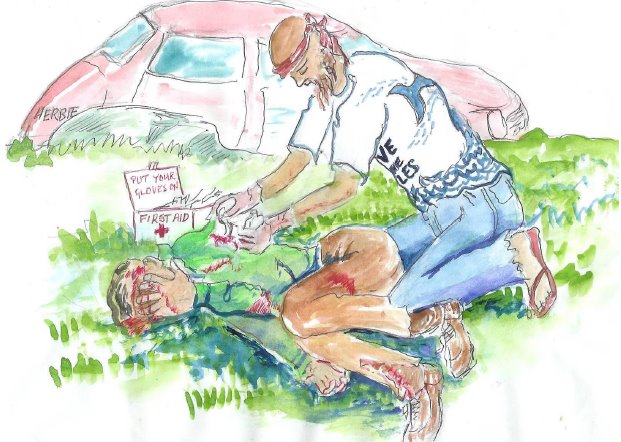 This picture was painted by my mother especially for the blog
 Hi,
I’m still talking about the 6 pillars of Character – Remember what they are? That’s TeRRiFiCC!! Trustworthiness, Respect, Responsibility, Fairness, Caring and Citizenship.
In my last
1 John 3:16-18 says
This is how we know what love is: Jesus Christ laid down His life for us. And we ought to lay down our lives for our brothers. If anyone has material possessions and sees his brother in need but has no pity on him, how can the love of God be in him? Dear children, let us not love with words or tongue but with actions and in truth.
Read the parable as Jesus told it in Luke 10:25 – 37. Instead of merely recounting the story, I hope you will allow me a little artistic licence and since it is Christmas time, I thought it would be fun to relate the story Pantomime style. This panto is set in
The Cast
The Narrator: Jesus himself.
A Bible school student: Young man, early 20’s, rides a mountain bike, carries a Bible in a Bible bag, complete with notebook, and pen.
The traveler: Ordinary South African, middle-class, drives a nice car, but not too flashy.
Hijackers: need I say more?
Tele-evangelist: Flash looking, tailored suit, fancy hair-style. Chauffer driven Merc (latest model.) Speaks with an affected American Drawl.
Tele-evangelist’s chauffeur: Wears a chauffeur uniform.
Deacon Fred: Middle aged, conservative dress (smart), short back and sides haircut. Drives a Ford pick-up. His accent suggests he was educated at a private Boys school in
Sam: Rather eccentric, a bit hippie, drives a multi-coloured VW-Beetle. Wears a bandana round his bald head. Accent and language is hip and happening. “Yeah dude!, W’sup?”
NB: All characters (except Jesus) are fictional and any similarity between them and people in real life is entirely, co-incidental.
Note all vehicles, except the student’s bike are stage set facades, only the side of the vehicle.
The Story
Curtains open and the Narrator is walking down a road. The Bible school student recognizes the Narrator as one of his/her lecturers. He catches up and stops to talk to him.
Bible Student (BS): Good morning sir! Having a nice day?
Narrator: Yes, actually thought I’d take advantage of the lovely weather to get some exercise, and you, where are you off to today?
BS: Oh, just taking a ride down to the local shop, thought I might see if there’s anyone I can persuade to come to church tomorrow. Tell me sir, what would you say, if someone asked: “How can I inherit eternal life?”
Narrator: Well, what would you say to them?
BS: Well in Deuteronomy 6 verse 5 it says “Love the Lord your heart and all your soul and all your strength”
Narrator: Mmmm
BS: And Leviticus 19 verse 18b says: Love your neighbour as yourself.
Narrator: So, what’s the problem, if you can do that, you will be alright.
BS: Yes, well, I suppose so, but suppose they ask “Who is my neighbour?” What do I say then?
Narrator: Let me tell you a story…..
Narrator and BS move to the side. As the Narrator speaks, the traveler comes on stage in his Peugeot Station Wagon. He’s traveling alone.
Narrator: A young businessman was driving down to
BS: What happened next? Did the guy die?
Narrator: No, but he needed medical attention. A few minutes after the attack, a big chauffeur driven Mercedes drove past. In the back, rode a well known tele-evangelist, The Reverend Matt Bishop.
Chauffeur and Tele-Evangelist come on stage in a Merc. Emblazoned on the side of the car are the words “BISHOP MINISTRIES INTERNATIONAL”
Chauffeur: Hey, did you see that man lying on the ground? It looks like he’s been attacked. Do you think we should stop and help him?
Tele-Evangelist: Are you mad, man? We have a HEALING SHOW, I mean service tonight at 6 p.m. in
Narrator: So they carried on their merry way, without a second thought for the poor man. A short time later, Deacon Fred came along the road. He was heading up to Jo’burg. He saw, our traveler lying on the ground and writhing in pain.
Deacon Fred: (to himself but out loud) That’s truly awful! The crime in this country is out of control. That poor fellow’s probably lost everything he has. Hope, he’s insured. The government really should do something about all this crime. I’d love to be able to help him, but you can never be too careful. After all, it may be a trap! As soon as I stop, they will jump out and steal my car. Still, I suppose I should pray for him…
BS: What did he pray?
Narrator: I don’t know, I don’t think God heard him.
BS: Well, did the guy just die there?
Narrator: No, not long after Deacon Fred, Sam drove past in his VW Beetle.
Sam comes on stage in the multi-coloured VW beetle and almost immediately notices the traveler in the lay-by. He pulls over.
Sam: Hey dude, what happened to you, man? You look pretty bad, man. Ag Shame. What can I do? Hey Dude, all this blood you’re losing, we need to get to a doc, like yesterday man. Hijacked hey? Poor guy. Hey, I’d give you tea or something, but you shouldn’t drink anything, in case you need an operation and they need to give you an anesthetic. Got this first aid kit in my car, carry it just in case. [takes out first aid kit, puts on Rubber gloves, removes bandages, ointment, etc.] Chill dude, it’s okay. Don’t thank me, it’s the least I could have done. Let me just get some ointment on this cut here, and then I will bandage it up. My bandages aren’t much, but they’re only temporary. The hospital will do a much better job. Now let’s see. How should we do this? Wait! I can’t move you, in case you’ve broken your back, or something. [Pause – puts ear near the traveler] What? You think your back’s ok. Okay listen, I’ll just get Herbie over here then, and you can lie down on the back seat while I take you to the nearest hospital. Sam, gets in “Herbie” and drives closer to the traveler. Sam gently helps Traveler to his feet and moves. Easy does it now! He helps him “get in” and then drives off stage.
Narrator: Later at the hospital, Sam made sure that the traveler was settled in, and had been seen by a doctor. He paid a deposit to cover the man’s hospitalization, and left his name and address, so that the hospital could forward the full account to him.
The Narrator: Well, who was a neighbour to that traveller?
BS: It the guy who stopped and helped him.
The Narrator: Yes, now you see, we need to be like him. He may not fit your mould of the “ideal Christian,” but he showed his love in practical ways. The best preaching is often done without words!
In the parable, as Jesus told it, the supposed heroes, the priest and the Levite, actually turn out to be the villains. The Samaritan, who was despised, emerged as the real hero of the story.
The message of the parable is clear: Your neighbour is everyone and anyone you come into contact with, regardless of race, religion or any other perceived difference. From the passage in 1 John quoted at the beginning, and many more beside, we learn that loving our neighbour means much more than merely mouthing the words, it must come from the heart, and it must be practical. It means being compassionate to everyone. It means we must care.
I’d like to say thanks to Mum for reading through umpteen drafts and giving her input especially in regard to correct English. Thanks too, to my nephew, and gave me a few pointers in writing this script. You input is valued. Thanks to you readers, and those who give me feedback. Now I wrote this skit just as kind of different way to tell the story, but if you want to use it, feel free. (I’d appreciate being told about it.)
In next
 No, It is not Valentine’s Day. The subject of this
Caring occurs at many levels and in many different ways. Because of this, it is hard to define in a succinct sentence. For the purpose of this discussion, I shall restrict myself to “caring for people,” although we also should care for animals, our environment, and property. I have highlighted the word in RED because Red is the colour ascribed to it by the Character Counts! Foundation.
What springs to mind when I think of CARING is the relationship between a parent and a child. Either the parent cares for the child, in terms of the child’s physical and emotional needs, or later in life, the child is caring for his or her parent in a similar way. It is widely accepted and expected that a parent should take care of his her child, provide food, shelter and clothing and then beyond an atmosphere in which the child can develop intellectually, physically and emotionally. A parent provides security for the child and a parent does his or her best to shield their child from harm.
Not wanting to undermine or diminish the familial obligation to care, it does stretch beyond that.
If we look in the Bible, we can see many examples of caring:
Pharaoh’s Daughter & Moses.
 “Then Pharaoh’s daughter went down to the
Then his sister [Miriam] asked Pharaoh’s daughter, “shall I go and get one of the Hebrew women to nurse the baby for you?”
“Yes, go,” she answered. And the girl went and got the baby’s mother. Pharaoh’s daughter said to her, “Take this baby and nurse him for me, and I will pay you.” So the woman took the baby and nursed him. When the child grew older, she took him to Pharaoh’s daughter and he became her son. She named him Moses, saying, “I drew him out of the water.”- Exodus 2:5-10
Shobi, Makir and Barzillai bring needed supplies to David and his men during the revolt of Absolom;
When David came to Mahanaim, Shobi son of Nahash from Rabbah of the Ammonites, and Makir son of Ammiel from Lo Debar and Barzillai the Gileadite from Rogelim brought bedding and bowls and articles of pottery. They also brought wheat and barley, flour and roasted grain, beans and lentils, honey and curds, sheep and cheese from cows’ milk for David and his people to eat. For they said, “The people have become hungry and tired and thirsty in the desert.” – 2 Samuel 17:27-29
These are just two examples, in the Old Testament that speak of people who showed compassion, and as a result took practical steps to help. Clearly, God used these people, in circumstances that God’s people found themselves. Clearly Pharaoh’s daughter was not Jewish. As I will point out in the next
Caring should be not be reserved for our own families, or even our own racial, ethnic or cultural group, but should be extended to everyone.
Pharaoh’s daughter did not focus on the fact that Moses was a Jew, though the text makes it clear that she knew he was one of the Hebrew babies, but what she focused on was that there was a baby in need. Yes the Lord moved in her heart and so orchestrated the situation to bring about his desired result, just as he may call on you to be caring to fellow human being who needs your help.
I had not previously read this story of Shobi, Makir and Barzillai.
| Shobi | The son of Nahash. Nahash, king of the Ammonites was no friend of the Jewish people. It is not clear here if the word “son” is literally implied, or meaning descendent of Nahash but the point to note in this context is that Shobi was not Jewish. Interesting background on Nahash can be found in 1Sam. 11 and 12:12 |
| Makir | Son of Ammiel. He was Jewish. He lived in the |
| Barzillai | Described as a Gileadite , Barzillai was of the half tribe of Mannasseh. Gilead, the place, was east of the |
Two or possibly three old men, one of them not Jewish, came to the aid of David and his men. They brought much needed supplies to them. Sometimes, we are tempted to make excuses as to why we are not in a position to help or care, but these three men serve as an example of how they served despite their age, or their social status. They may not have been able to become fighters alongside David, but their role of bringing food to David and his men, was as essential as the role of those on the frontline. We should not waste time bemoaning the fact that we can’t help in some “BIG” way, but see what we CAN do and know that our contribution is important too.
Caring, is I think a value in life that demands more of us than the other values we’ve been discussing. If you love someone, caring comes as a natural outflow of that love.
John 13:34 – [Jesus said,] “A new commandment I give you: Love one another. As I have loved you so you must love one another. By this all men will know you are my disciples, if you love one another.”
1 Corinthians 12:25b-26 “..., but that its parts [parts of the Body – the Church] should have equal concern for one another. If one part suffers, every part suffers with it; if one part is honoured, every part rejoices with it.
1 Corinthians 13:3-4 “If I give all I possess to the poor….but have not love, I gain nothing. Love is patient, love is kind, …”
In other words Caring without love is a waste of time, but love is caring.
Galatians 6:2 “Carry each other’s burdens and in this way you will fulfill the law of Christ.”

James 1:27 Religion that God our Father accepts as pure and faultless is this: to look after orphans and widows in their distress and keep oneself from being polluted by the world.
James 2 – The whole chapter has relevance, but I highlight just verses 15 to 17: “Suppose a brother or sister is without clothes and daily food. If one of you say to him, “Go, I wish you well; keep warm and well fed,” but does nothing about his physical needs, what good is it? In the same way, faith, by itself, if not accompanied by action, is dead”
1 Peter 4:10 – Each of you should use whatever gift he has received to serve others, faithfully administering God’s Grace in its various forms.
1 John 4: 19-21 “We love because He first loved us. If anyone says, “I love God,” yet hates his brother, he is a liar. For anyone who does not love his brother whom he has seen, cannot love God, whom he has not seen. And He has given us this command: Whoever loves God must love his brother. (I need to point out that Peter was not speaking merely about blood-relative, but anyone and everyone.)
The quintessential text about caring is the story of the Good Samaritan. We will examine the Parable of the Good Samaritan in the next
Coming Soon, to a computer screen near you!
The Good Samaritan

